Hillside Prototype House
The Hillside Prototype is a speculative exploration of a hillside dwelling for the okanagan valley. It represents a critical commentary on and response to prevailing local development practices, aiming to chart a path towards a regionally responsive architecture that treads lightly on the land.
In an era marked by urban expansion, the allure of steep forested slopes has led to the proliferation of new subdivisions. However, conventional approaches often entail the wholesale clearance of forests and extensive terraforming, resulting in a stark departure from the area’s natural character.
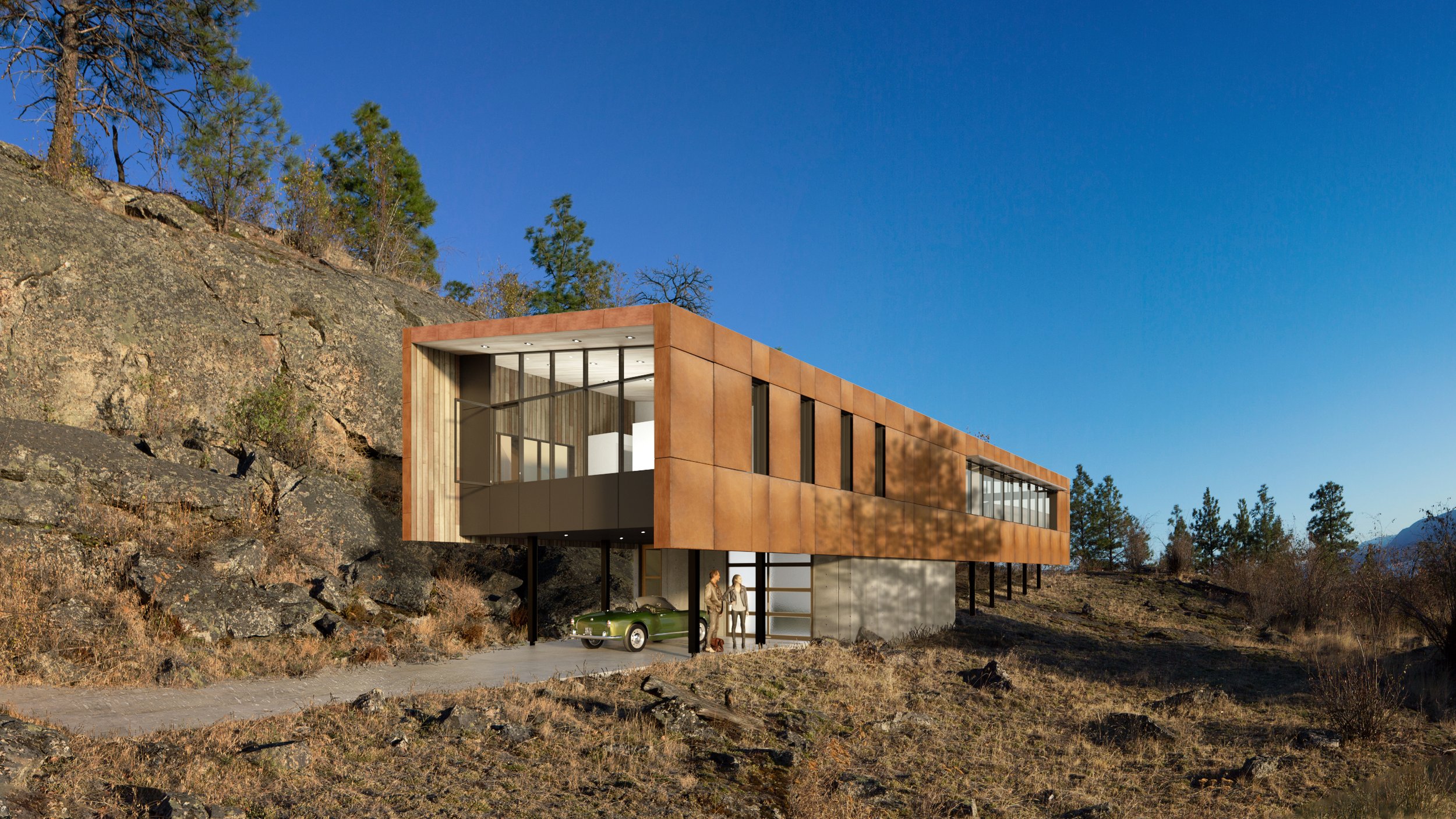
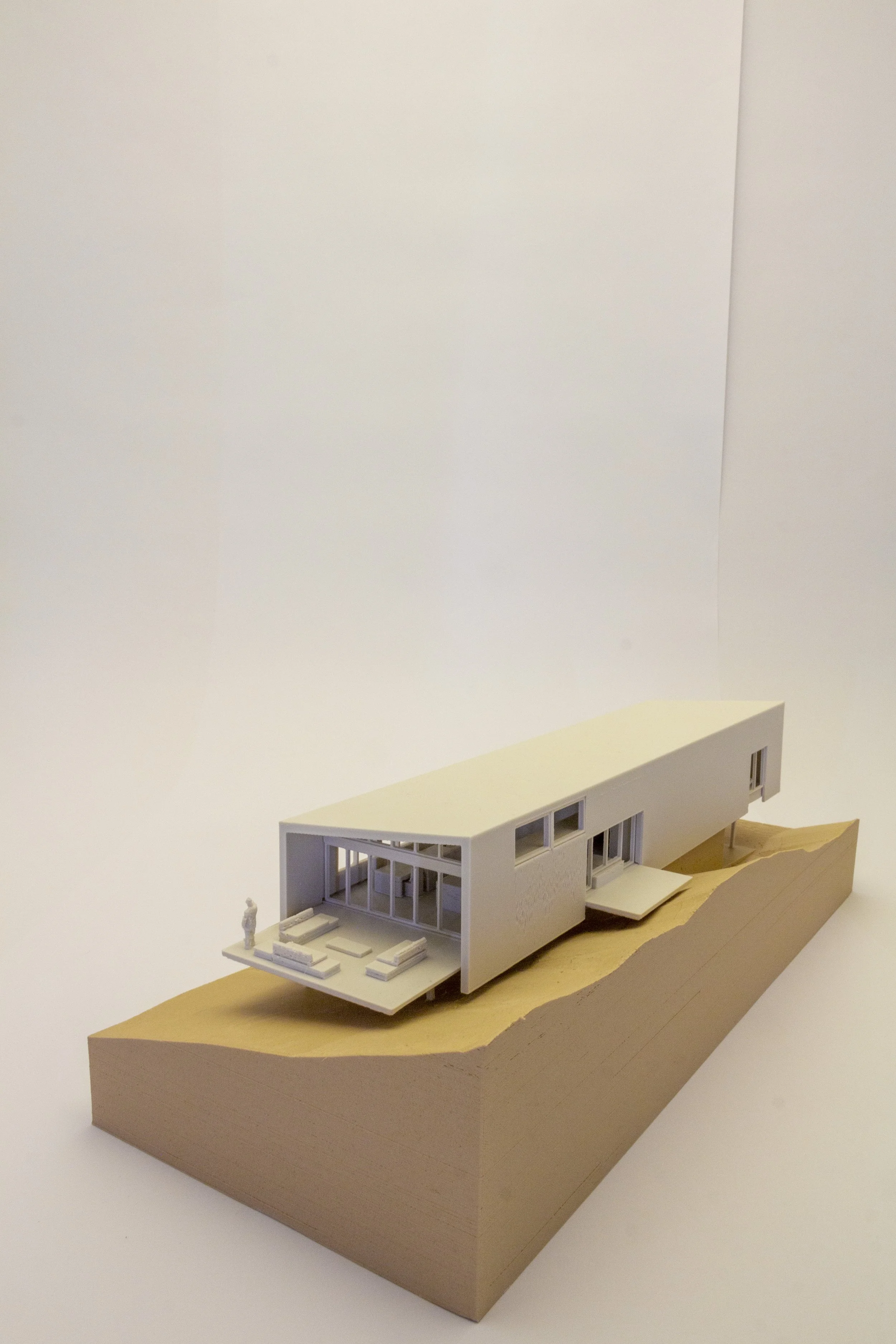
The Hillside Prototype embraces the landscape rather than diminishes it. Departing from traditional construction paradigms reliant on extensive concrete foundations and retaining structures, this prototype adopts a minimalist ethos to reduce both embodied carbon and site disruption. By employing steel posts anchored directly to the bedrock, the dwelling achieves a seemingly weightless quality, preserving the intrinsic integrity of the terrain beneath.
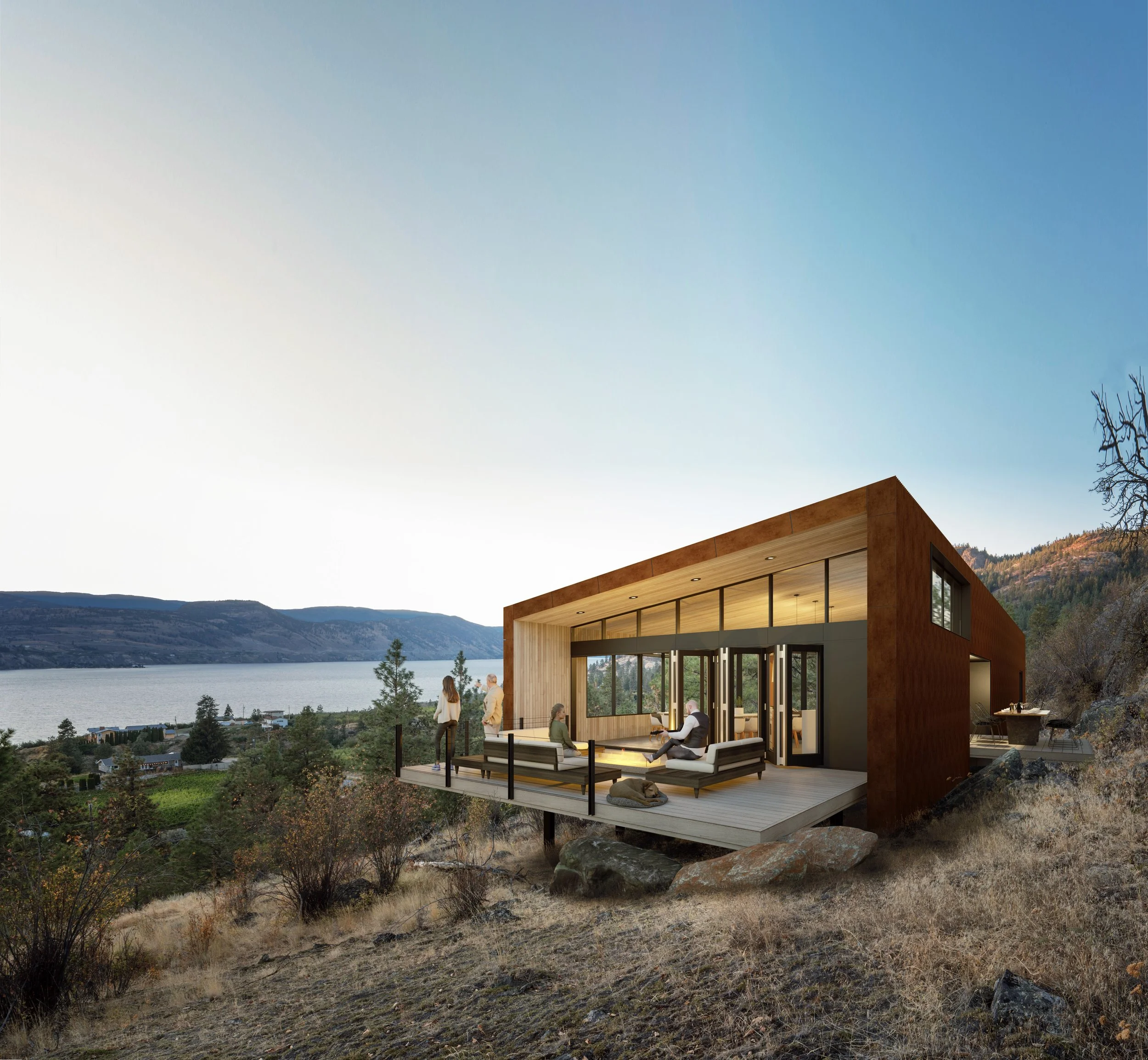
A weathering steel ‘shell’ provides wildfire resilience using fully recyclable cladding and roofing. Fenestration embraces passive solar fundamentals by locating large openings with deep overhangs on the south and roll-down shutters on the west. The house, through carefully located windows and patios, fosters a profound connection with nature. This intentional integration cultivates a sense of “lived connection,” wherein inhabitants associate themselves more as stewards of their local environment rather than usurpers.
Through its speculative inception, the Hillside Prototype serves as a catalyst for three subsequent projects, all of which are either under, or soon to begin, construction.
The Hillside Prototype: A Typology for Steep Terrain
I. Context and Challenge The transition of Okanagan development from flat benchlands to steep, rocky hillsides presents a significant architectural challenge. Conventional construction methods, often reliant on "blast and fill" excavation, impose flat building pads onto complex topography. This approach requires extensive retaining walls, disrupts natural drainage patterns, and permanently alters the site’s ecology.
The Hillside Prototype offers an alternative methodology. It serves as a case study in adaptation, demonstrating that building form can adjust to the land rather than forcing the land to accommodate the building. This typology prioritizes a lighter footprint, reduced embodied carbon, and is a direct response to the semi-arid climate.
II. The Anchor: Pinning to Bedrock The defining tectonic move of the prototype is its rejection of the continuous concrete foundation. On sites dominated by solid bedrock, the traditional basement is replaced by a system of steel posts anchored directly into the stone.
This "pinning" strategy creates a structure that hovers above the existing grade.
Site Preservation: By lifting the building volume, the native slope, hydrology, and flora remain largely undisturbed beneath the home.
Geological Response: The architecture acts as a distinct vessel that docks with the geology, utilizing the compressive strength of the rock without requiring its removal.
III. The Shell: Armouring for Wildfire Situated in the wildland-urban interface, the Hillside Prototype addresses the reality of wildfire through material selection. The residence is wrapped in a "shell" of weathering steel (Corten).
This cladding serves a dual purpose:
Resilience: As a non-combustible material, the steel carapace hardens the structure against sparks and radiant heat, offering a level of protection superior to traditional wood siding.
Camouflage: The oxidized patina of the steel mirrors the iron-rich bedrock and the dark bark of the surrounding Ponderosa pine forest. The building does not stand out as a foreign object but recedes visually into the landscape.
IV. The Form: The Wedge and Visor Solar management is the primary driver of the building’s profile. To mitigate the intense summer heat of the Okanagan while preserving panoramic lake views, the design employs a mono-slope "wedge" roof form.
The Visor Effect: Deep roof overhangs function like a camera lens hood, blocking high-angle summer sun to prevent overheating and glare.
Passive Performance: This calibrated shading reduces reliance on mechanical cooling, allowing the home to remain comfortable through passive means while framing clear views of the valley.
V. The Water Feature: The Industrial Trough Where a pool or water feature is required, the typology rejects the construction of retaining walls to create artificial flat land. Instead, it adopts the logic of the historical irrigation flume.
The "Trough" concept treats the pool as a structural object—often a cantilevered concrete beam or repurposed industrial container—that projects from the main volume. This approach maintains the "touch lightly" ethos, suspending the water in the air rather than burying it in the slope.
VI. Summary The Hillside Prototype establishes a set of principles for dwelling on the edge. By anchoring lightly, shielding effectively, and armouring against the elements, it proposes an architecture of stewardship—one that inhabits the hillside without conquering it.