Retreat above Arawana Station
Arawana Retreat is a compact house on a steep hillside above Naramata, where long western views across Okanagan Lake are balanced by limited privacy and very little level ground. The clients wanted three bedrooms, generous shared living spaces, and a strong connection outdoors, but were comfortable keeping the overall house small.

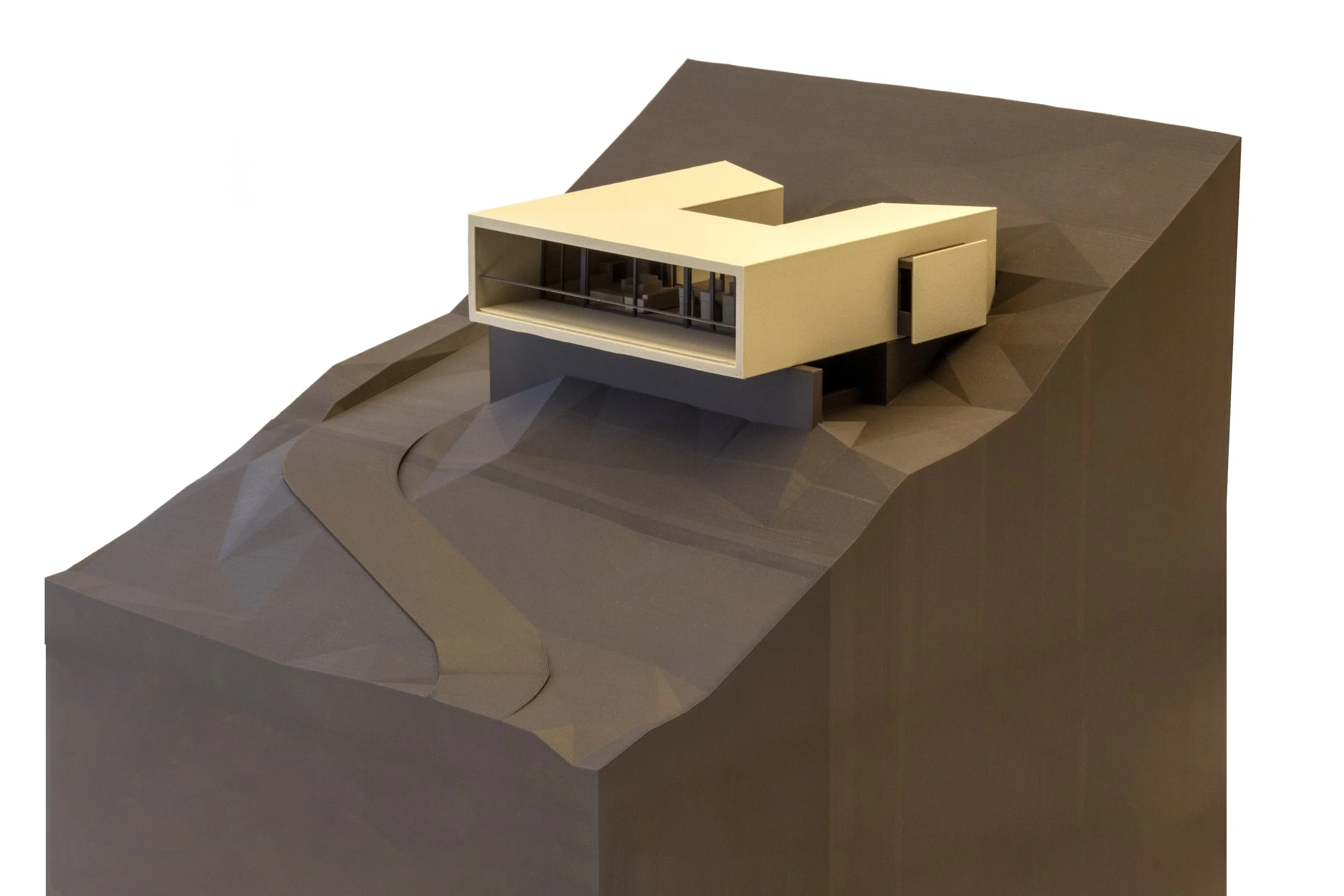
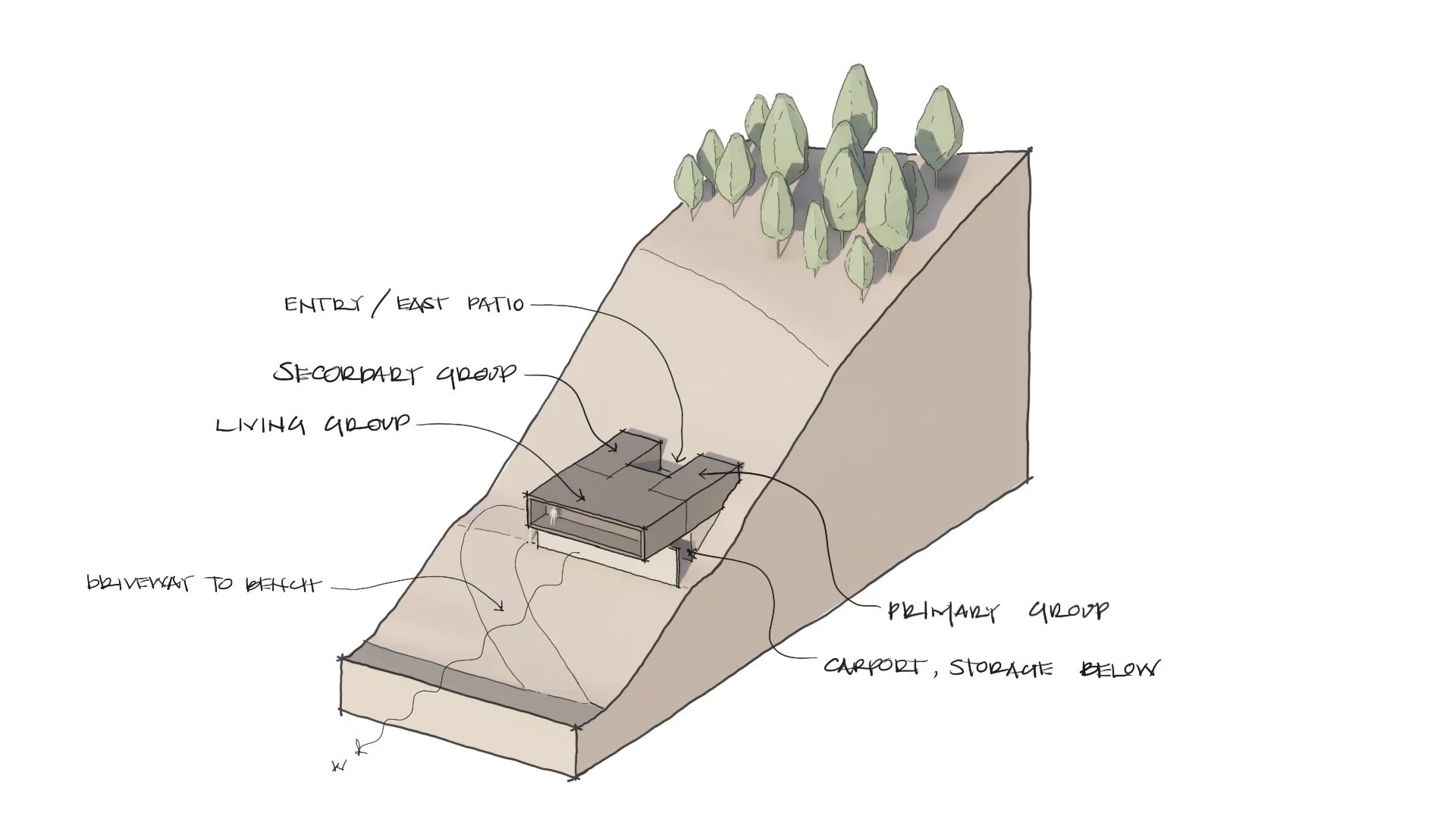
The plan is organized around an elevated courtyard, with the bedrooms placed in two narrow wings and the living, dining, and kitchen spaces spanning between them. This arrangement creates a protected outdoor room at the centre of the house without adding heated floor area. Large sliding doors open on both sides of the dining room, allowing the courtyard, dining space, and west-facing terrace to operate as a continuous sequence through the building.
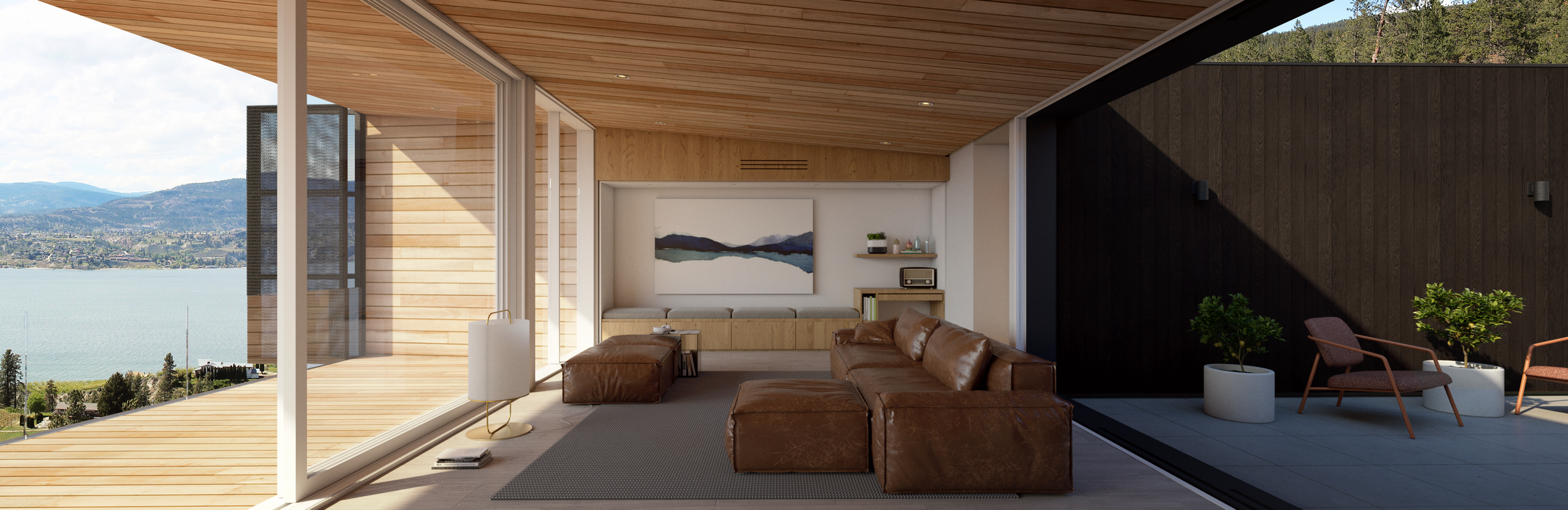
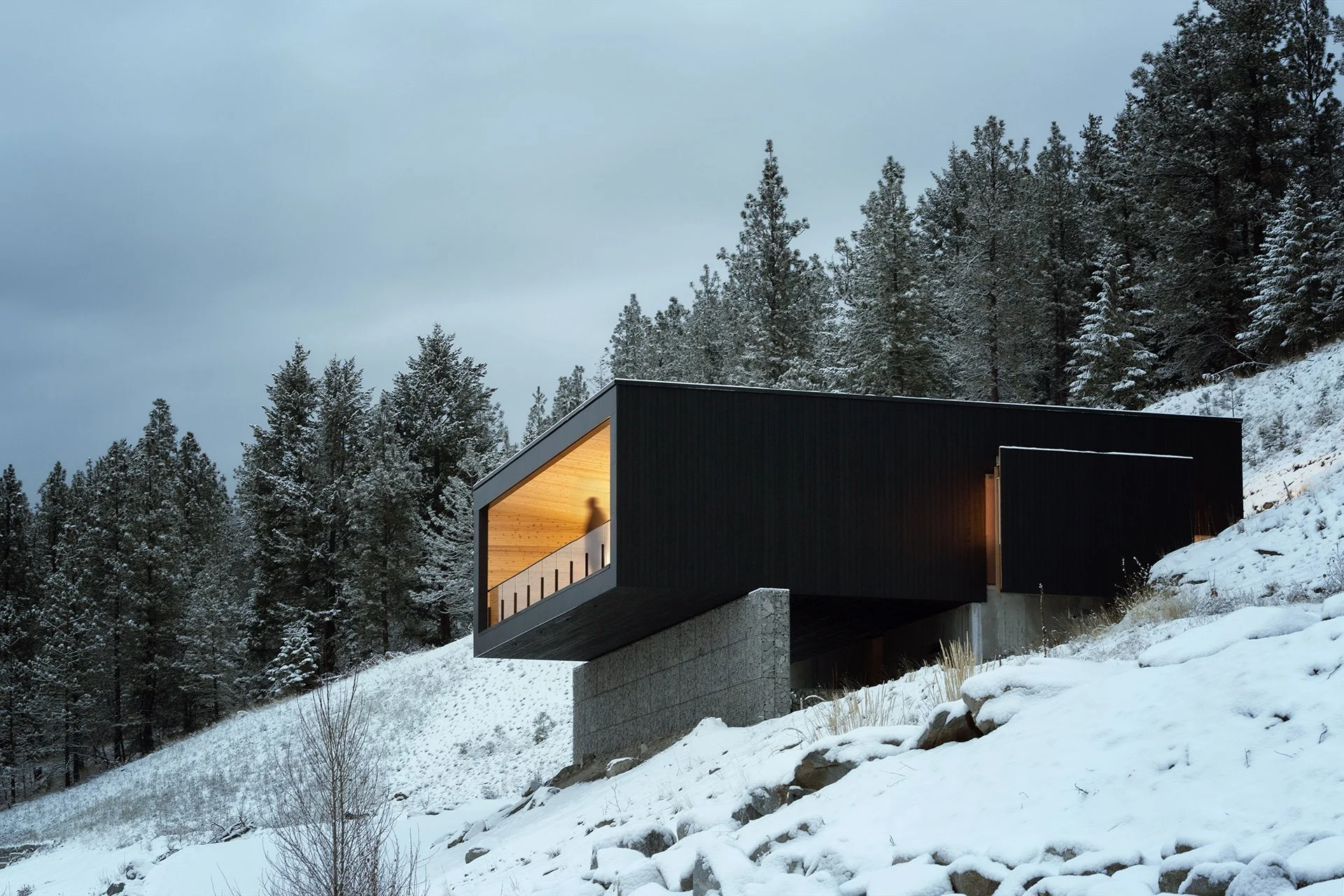
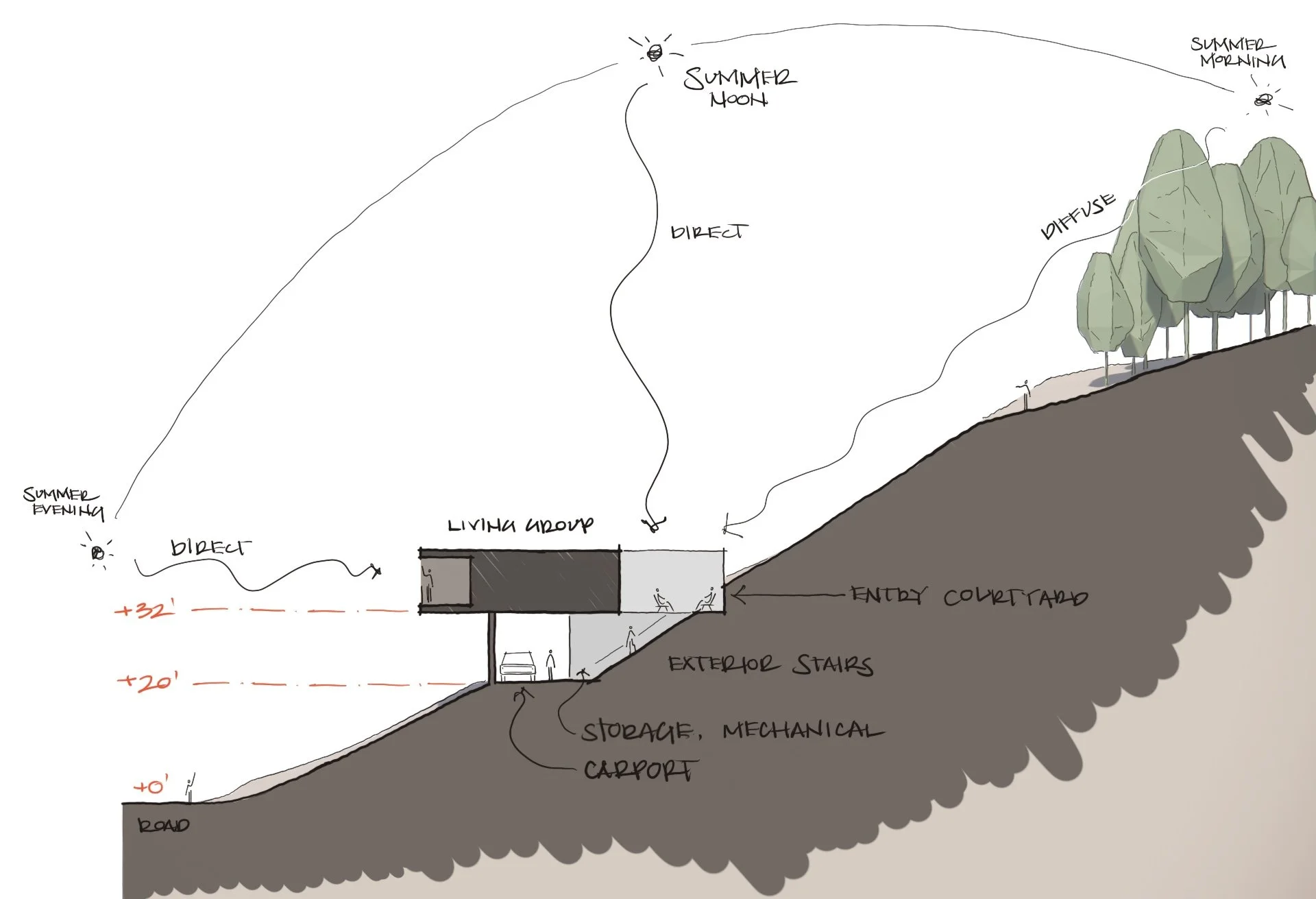
The living room reaches outward from the hillside toward the lake and Giant’s Head Mountain. From the uphill foundation to the outer edge of the cantilever, the structure spans 26 feet, with the final 10 feet projecting beyond the gabion wall below. A deep exterior shroud shades the west-facing glass, limits views from neighbouring properties, and concentrates the outlook toward the distant landscape.
Although the gabion appears to carry the house, the weight is actually transferred through steel posts concealed behind it. The stone wall screens the carport below and gives the cantilever a sense of weight and support, while its fill reuses rock removed during construction.
Site-charred cedar wraps the exterior, reducing the visual contrast between the house and the wooded hillside. The treatment was selected for durability and wildfire resilience, while wood is used more freely inside, where warmer surfaces contrast with the dark exterior shell.
At approximately 1,300 square feet, the house relies on section, outdoor rooms, and carefully framed views rather than added floor area. The result is not an attempt to make a small house appear larger, but to give a modest plan several distinct ways to be occupied.
Field Notes: Arawana Retreat
Reducing Rock Excavation
Early in the design process, we compared the cantilevered scheme with a more conventional house embedded into the hillside, similar to neighbouring construction. That study indicated that projecting the main floor reduced the area requiring rock excavation by approximately 55 percent.
Blasting was still required at the uphill side of the site to create space for the carport, mechanical room, and foundations. Rather than extending that cut beneath the full building footprint, the living spaces project outward over the existing grade. All of the resulting blast rock remained on site and was reused in the gabion wall.
A Wood House on Three Steel Columns
The portion of the house beyond the uphill foundation is carried by three steel columns bearing on concrete foundations pinned to bedrock. These supports carry approximately half of the main-floor area, while the structure above is primarily wood.
LVL beams and joists form the cantilever, with TJI joists used elsewhere in the floor system. Steel braces beneath the projecting volume resist lateral forces and remain visible from the carport, although they are concealed from the exterior by the gabion wall.
Foundations on Discontinuous Bedrock
The foundations were initially designed with the expectation that bedrock would remain relatively continuous beneath the house. During excavation, the rock was found to fall away beneath portions of the building.
The foundation system was adjusted to include reinforced concrete grade beams spanning between reliable areas of bedrock. This allowed the house to remain in its chosen position without additional excavation or a fundamental change to the design.
The Gabion Does Not Support the House
The gabion appears to carry the cantilever, but it is not part of the building’s gravity structure. Its role is to screen the carport, conceal the columns and lateral bracing, and provide enough visual weight beneath the projecting house.
A tall freestanding wall of loose stone would be vulnerable during a strong earthquake, so the steel structure was erected first and the gabion baskets were secured to it. The steel stabilizes the wall and prevents the baskets from falling apart during seismic movement, while the house remains independently supported on the columns behind.
Every stone in the gabion came from the site. The visible face was arranged by hand during construction, giving the wall a more deliberate surface than could be achieved by simply filling the baskets from above.
A Courtyard That Shelters and Ventilates
The courtyard faces east, where it receives morning light while remaining protected by the bedroom wings and the surrounding hillside. During stronger weather, the enclosing walls shelter it from the winds moving across the exposed slope.
Under calmer conditions, the courtyard can also collect the gentler daily air movement created by temperature differences between Okanagan Lake and the surrounding hillsides. Large sliding doors on either side of the dining room create a direct ventilation path between the courtyard and the western terrace, allowing accumulated heat to be flushed from the narrow floor plate.
The house also has mechanical cooling. In the Okanagan, heat domes can push daytime temperatures beyond 40°C while nights remain near 25°C. Natural ventilation is useful when conditions allow, but mechanical cooling remains necessary for health and safety during extreme heat.
A Ten-Foot Western Shroud
The west-facing shroud extends ten feet beyond the glazing. Its depth protects the terrace and interior from wind and rain, delays direct afternoon sun, and limits views from the neighbouring side yards.
Because the adjacent lots were still unbuilt during design, the exact form of future privacy concerns could not be known. The shroud provides a degree of protection from oblique views while keeping the long outlook toward Okanagan Lake and Giant’s Head Mountain open.
Low evening sun eventually reaches beneath the overhang. The shroud moderates western exposure rather than pretending it can eliminate it.
Bedroom Pop-Outs
The bedrooms were intentionally kept smaller than those in many contemporary houses. Rather than adding floor area, each room includes a wood-lined pop-out that extends toward the landscape.
These alcoves work in a similar way to slide-outs in a recreational vehicle. Their windows look uphill and downhill, providing views toward the rocky slope and Okanagan Lake without opening directly toward the neighbouring side yards. In the smaller bedrooms, the pop-outs also provide built-in seating and places to read without requiring additional furniture.
The primary bedroom uses the same strategy at a larger scale, with narrow windows on either side of the bed framing the ground and view while maintaining privacy.
Compact Planning Without Extra Rooms
The clients chose to reduce the size of the bedrooms and bathrooms so that the shared living spaces could remain generous within a 1,300-square-foot house. The program does not include the additional office, gym, studio, media, or flex rooms that often expand residential projects beyond their original needs.
Storage and appliances are concentrated within the architecture. In the kitchen, the full-height oak wall contains the refrigerator and freezer on one side and the pantry on the other, keeping the working parts of the room within a single organized surface.
The house achieves variety through the courtyard, terrace, built-in alcoves, views, and changes in exposure rather than through a larger collection of rooms.
An Entry Facing the Blast Cut
The entry window looks directly toward the exposed rock created during excavation. Rather than hiding the cut behind landscaping or a blank wall, the opening brings the geological condition of the site into the arrival sequence.
This close view works differently from the broad western outlook. At the entry, the house looks back into the hillside and the work required to occupy it. Only after moving farther into the plan does the view open toward the lake.
Site-Charred Western Red Cedar
The exterior is clad in six-inch tongue-and-groove Western red cedar that was charred on site by the builder. During winter, the area beneath the completed cantilever became a temporary workshop where the boards could be treated out of the weather, then installed on the building in spring.
The charred surface does not require a finish to be reapplied. Behind the cedar, a ventilated rainscreen and exterior mineral-wool insulation form part of the wall assembly. Metal vents and mineral wool within vulnerable cavities help reduce the paths through which embers could enter the enclosure.
Wildfire resilience does not depend on the charred wood alone. It comes from the complete assembly: cladding, cavity protection, insulation, vents, roof edges, and the way the building meets the surrounding ground.
A Warm Interior Within a Dark Shell
The dark exterior gives way to an interior lined mainly in cedar, with oak used for selected millwork. The cedar ceiling continues through the living spaces and beneath the protected western shroud, while oak is concentrated in built-in elements such as the kitchen wall, bedroom alcoves, storage, and furniture.
The distinction is practical as well as visual. Wood is used most extensively where it is protected from direct weather, while the charred exterior surface is detailed as part of a ventilated and insulated enclosure.